
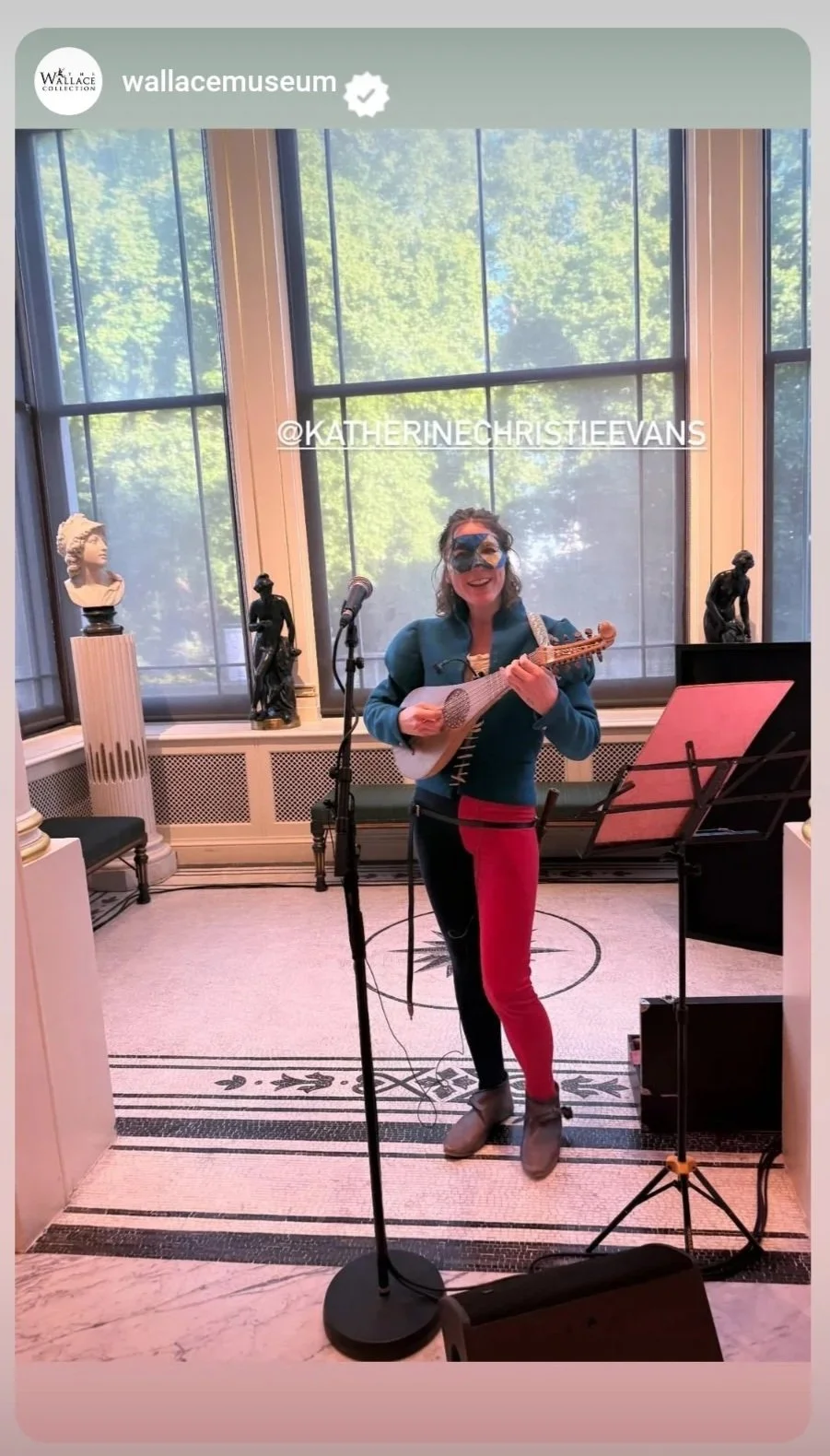
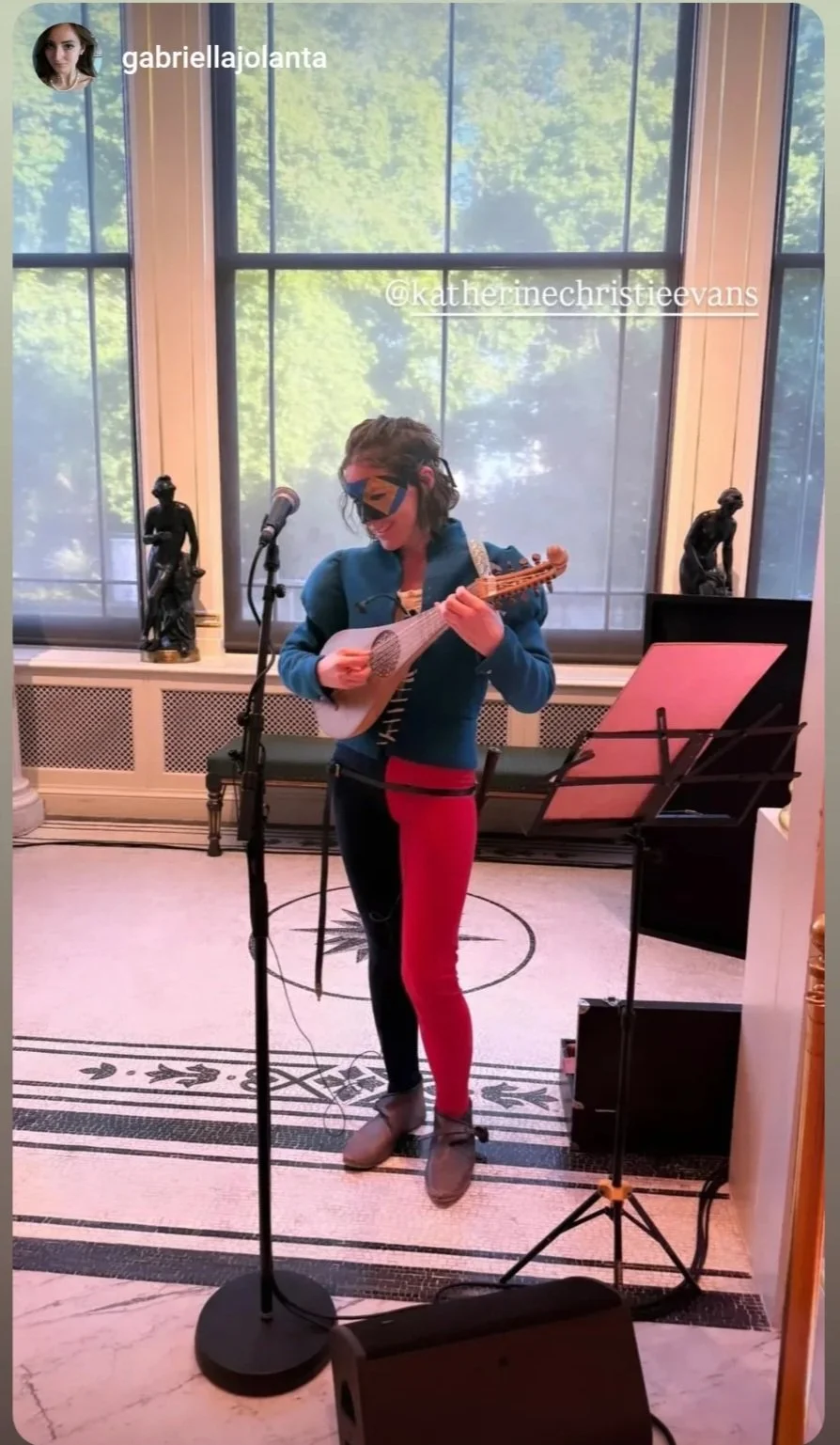
LIVE AT THE WALLACE COLLECTION MUSEUM IN LONDON!
On Friday 3rd July 2026 I had the honour of performing in full costume with my gittern, at The Wallace Collection in central London, for their LGBTQIA+ Grand Ball!


NEW RELEASE, February 2026!
“Quant la Doulce Jouvencelle”
Happy LGBT+ history month! I filmed this in a stunning medieval church hidden in a remote valley near the Welsh border, a rare gem featuring incredible thirteenth-century wall paintings.
There are many refined and sumptuous recordings of this song, all of them beautiful. I consider this to be the queer peasant’s version! ‘Quant la Doulce Jouvencelle’ is a beautiful 15th century love song by an Anonymous composer, for 3 parts/ voices. It was collected in a manuscript of Italian origin, now named ‘MS. Canon. Misc. 213’ and housed at the Bodleian library, Oxford.
21st November 2025
“Lucente Stella (Shining Star)”- Artwork by Tokamu
Lucente Stella or ‘Shining Star’ is an anonymous Medieval love song found in an Italian manuscript from the 1400s, the Codex Rossi.
It is is a melancholic but beautiful song of distant and impossible love. In my contemporary re-imagining of the song, in draw inspiration from IDM and techno, NIN, game music and 1980s film soundtracks.
The vocal melody weaves through a dark, atmospheric soundscape featuring layers of overdriven guitar, ambient sound design and analogue drums.
The music release is accompanied by a stunning original video by Italian multimedia artist Thomas Tokamu. His glitchy, technological visuals help bring this song into the present day.
Lucente Stella is my first release in this experimental electronic style, and will be followed by many others!
“Mariam Matrem Virginem”
from the Llibre Vermell manuscript, Catalonia, 1300s
In this music video I am honoured to collaborate with talented dancer and artist Kait Dron, who I met this summer in Pembrokeshire, Wales at a ‘Butoh’ dance workshop (Japanese contemporary dance theatre). Here we have set out to combine Butoh with Medieval Music.
One of 10 songs from the Llibre Vermell (Red Book), a 14th century manuscript kept in the Benedictine Monastery of Montserrat in Catalonia, Spain, it is a song of pilgrimage to visit the Black Madonna, a sacred statue in the Monastery.
Montserrat – meaning “serrated mountain” because of its stunning jagged rocks – has been a major pilgrimage site since the Middle Ages.
“Lanquan li jorn”
Troubadour song
"Lanquan li jorn son lonc en may", or "In May, when the days are long", is a 12th Century Troubadour song by Jaufre Rudel. He is attributed with developing the recurring troubadour theme of love from afar, or ‘amor de lonh'.
Filmed on location at the redundant Medieval church of St Cyriac & St Julitta in the village of Swaffham Prior, Cambridgeshire, UK, built circa 1216. A strange and beautiful building, with stunning acoustics!
“Adiu, Adiu, Dous Dame Jolie” or “Farewell, Farewell, Sweet Lady”
by Francesco Landini (c.1335-1397)
“Adiu, Adiu, Dous Dame Jolie”, or "Farewell, Farewell, Sweet Fair Lady” is a beautiful and bittersweet song of lost love and exile. It is sung in Old French, and I have arranged it here for gittern (medieval guitar).
The video was shot in two of Birmingham’s most iconic abandoned buildings, as I transport the medieval song into the present day. I imagine a queer protagonist on the margins of society, in a dystopian landscape.
“Je ne Cuit Pas Qu’oncques à Creature”
by Guillaume de Machaut
‘Je ne Cuit Pas Qu’oncques à Creature’ (I Do Not Believe That To Any Creature Ever) is a 14th century ballade by Guillaume de Machaut, one of the most famous composers and poets of the 1300s. In the video I am playing a gittern (medieval guitar) and singing in Old French, and I recorded the performance with just one ribbon microphone for simplicity.
Volez vous que je vous chant (Would you like me to sing?)
- Anonymous 12th/ 13th C. Trouvère song
Arranged for voice and gittern by KCE.
Volez vous que je vous chant (Would you like me to sing?) is an anonymous Trouvère song. The trouvères were the Northern counterparts to the Troubadours of Southern France. Written in the 12th or 13th century, the song is a ‘reverdie’ - a dreamlike song of love, nature and the seasons.

If you enjoy my work, please considering buying me a coffee